
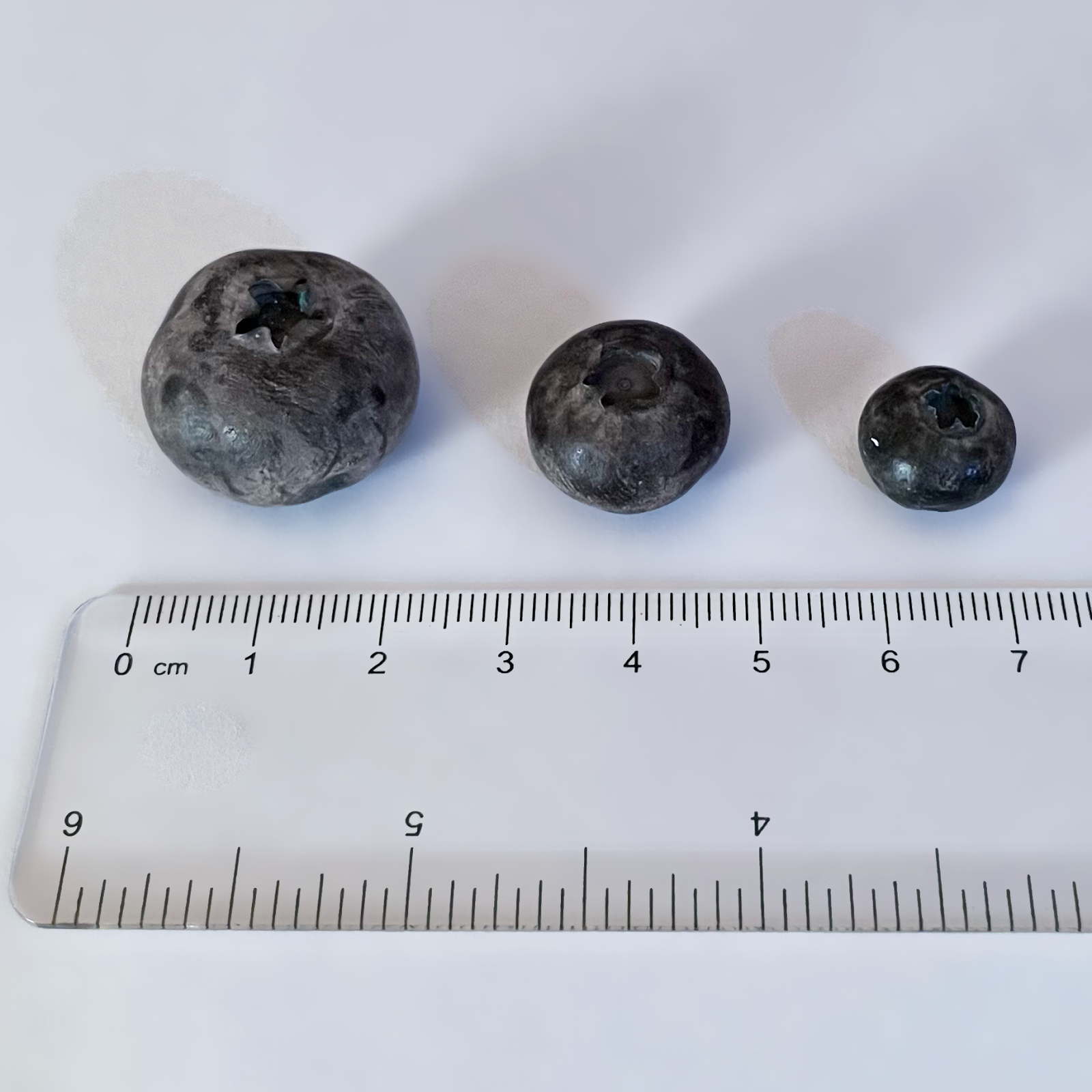
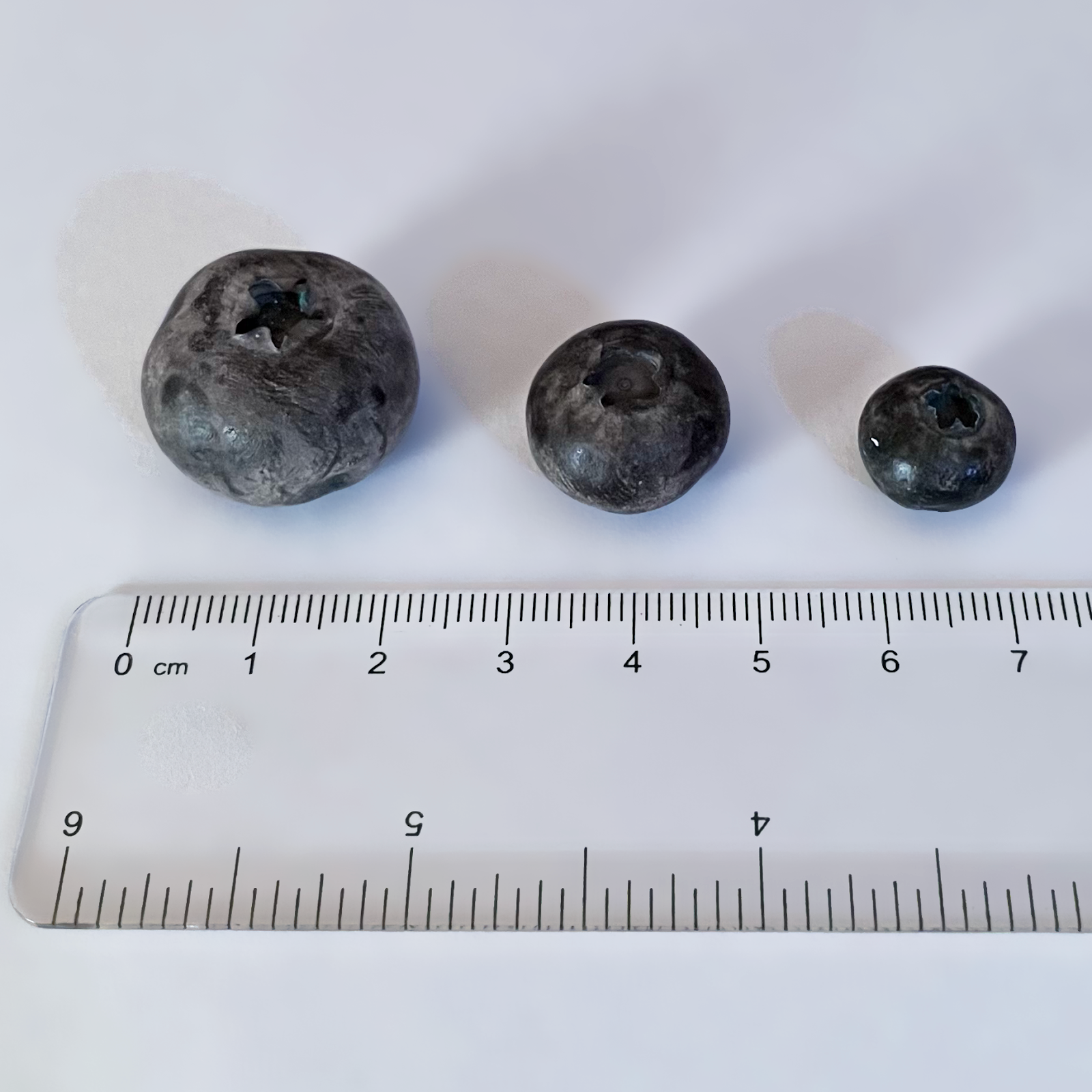
If you make a blueberry pie, you’ll need … well … blueberries! You may notice that blueberries in the grocery store come in many sizes. Which should you choose? Fortunately, mathematics and the number pi are here to help you. While your main goal may be making a pie that is delicious, perhaps you also want the pie to have as many antioxidants as possible. Antioxidants are healthy chemicals, and blueberries contain them in their skin. In fact, they are what make blueberries blue! You are led to the following mathematical question. Which has more antioxidants: blueberry pie with big berries or small berries?
To see what the answer is, let’s bring out some math. First, let’s recall a few facts from geometry. The volume and surface area of a sphere of radius r are
Volume = 4/3 π r3,
Area = 4 π r2.
Suppose the recipe calls for a volume of 1 cup of blueberries. If the berries are spheres of radius 1 cm, then each berry has a volume of: 4/3 π 13 cm3 ≈ 4.19 cm3. As 1 cup is approximately 236.6 cm3, we’ll have around 56 blueberries. Now, let’s see how much skin we have in total. Each berry has a surface area of 4 π 12 cm2 ≈ 12.6 cm2. Since there are 56 blueberries, there is a total of 56 * 12.6 cm2 ≈ 705.6 cm2 of skin.
Let’s repeat the same calculation with a smaller berry of radius 0.5 cm. Each berry has a volume of:
4/3 π 0.53 cm3 ≈ 0.524 cm3. In 1 cup, we’ll have 236.6 / 0.524 ≈ 452 blueberries. Each berry has a surface area of 4 π 0.52 cm2 ≈ 3.14 cm2. Since there are 452 blueberries, there is a total of 452 * 3.14 cm2 ≈ 1419 cm2 of skin.
What do we observe? We see that there is more blueberry skin in a cup of small blueberries than a cup of large blueberries. All else equal, more skin means more antioxidants. So we conclude that the pie with smaller blueberries has more antioxidants!
In doing our calculations, we made some assumptions. Let’s clarify those here. We assumed that blueberries are perfect spheres. In our calculation, we considered 1 cup of blueberries, but if we actually filled a measuring cup with blueberries, there would be many gaps between the berries. We also assumed that the density of antioxidants in the skin of large blueberries was the same as that in small blueberries. All of these are approximations, but the mathematics still tells us something meaningful and actionable. If we were blueberry farmers, this math may help us select which type of blueberry to grow based on how our blueberries will be used once harvested.
If you liked this mathematical story, here are a few things you can do:
1.) Compute how much surface area is in 1 cup of blueberries of radius r. By looking at the formula, can you see that smaller blueberries have more surface area and hence more antioxidants?
2.) Consider attending the Tapia STEM Camps at Rice University in Houston, TX. These camps are a 6-day/5-night experience where you get to explore a variety of ideas across many fields of STEM. Past campers have engaged this problem about blueberries, and we have many more just like it. Find out more about our STEM Camps and our camp called Techniques of a Pro Mathematician.
Happy pi day everyone. May your pies be delicious and full of antioxidants!
— Dr. Paul Hand, Ph.D., Executive Director, Tapia Center
