
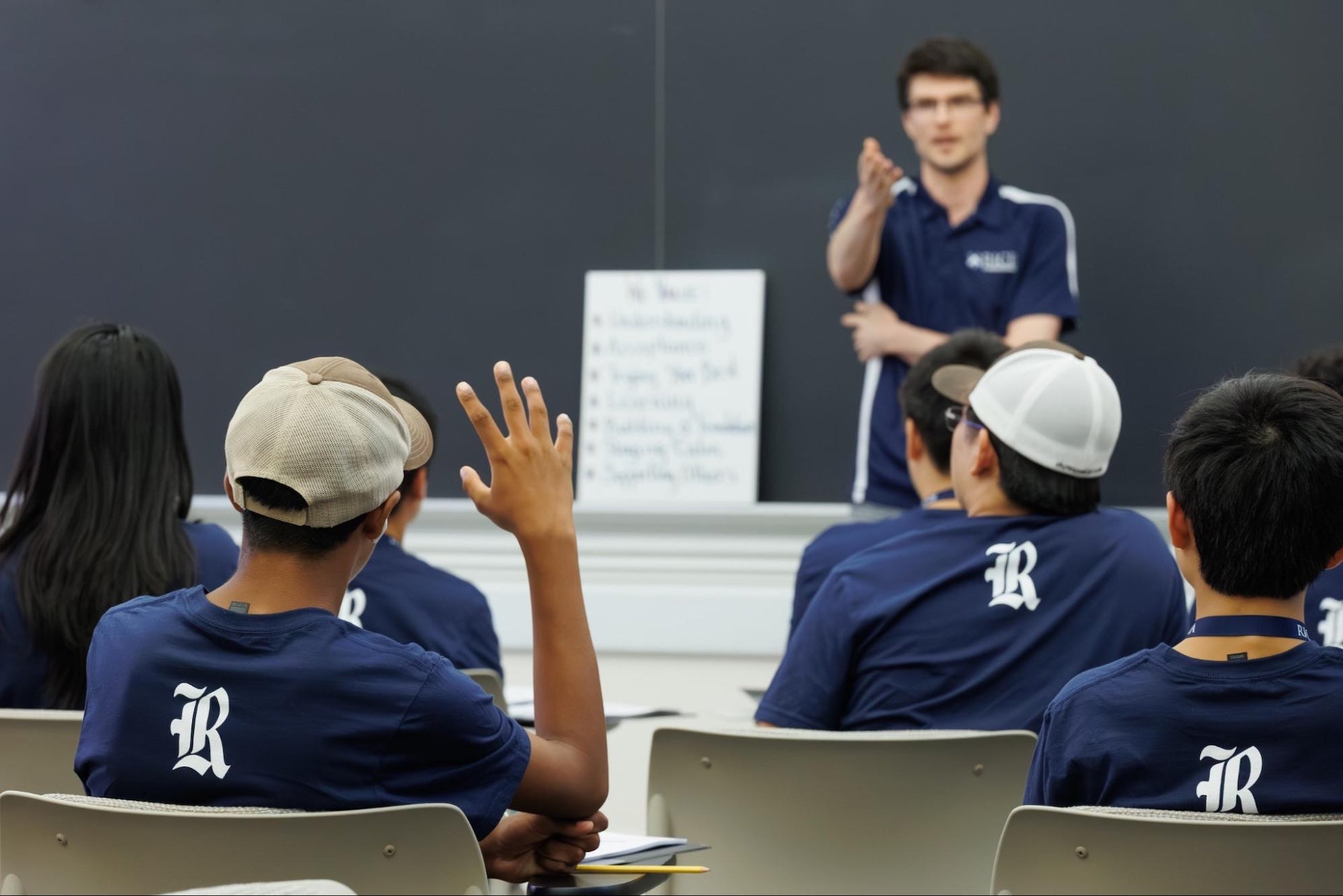
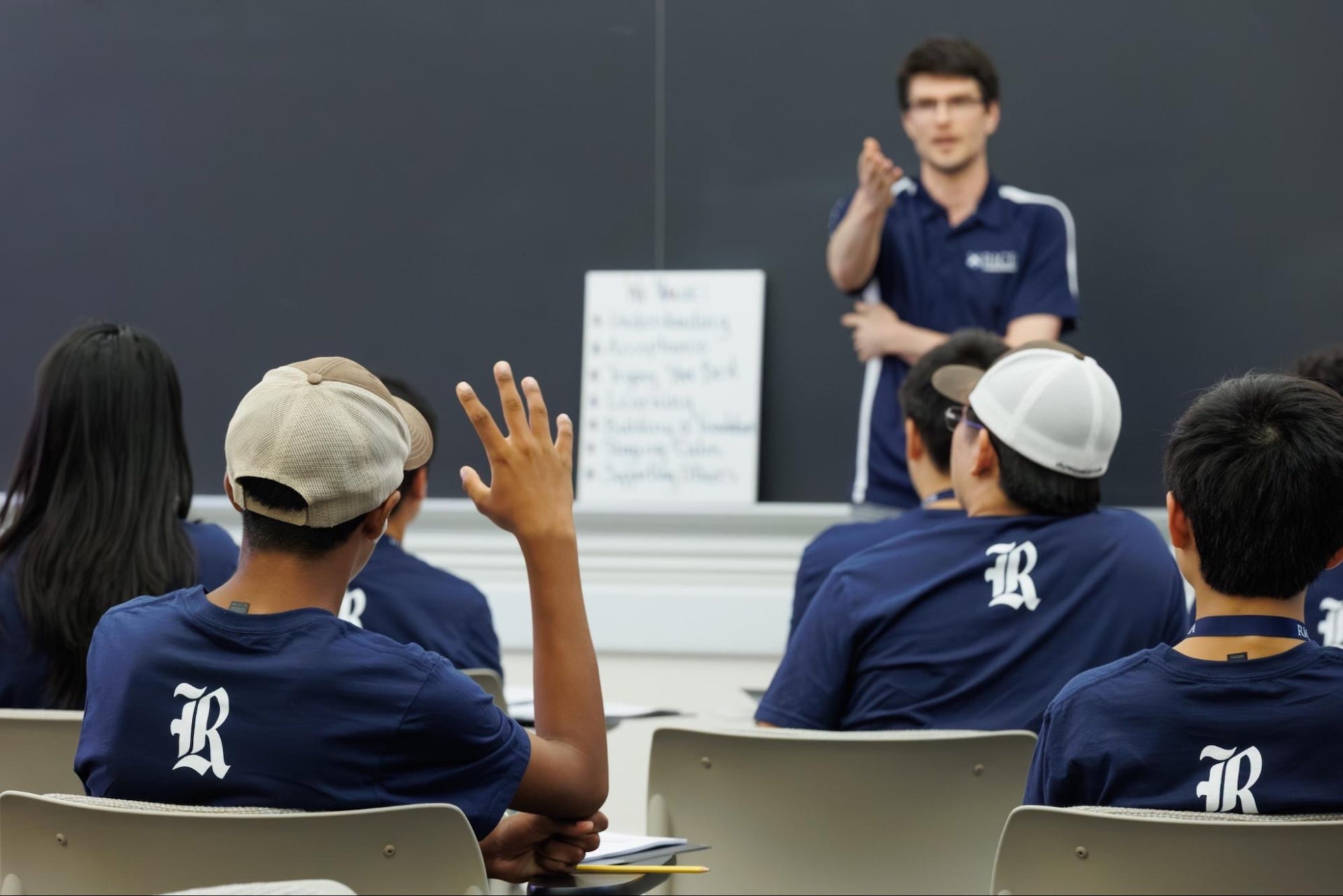
We at the Tapia Center are excited to again offer our week-long math camps during Summer 2026. These programs use the “Techniques of a Pro Mathematician” curriculum, which I developed for students who have completed high school geometry and intend to go to college and major in a quantitative field like math, physics, computer science, AI, or engineering. College-level math can be intimidating to many, but with the right foundational skills for mathematical thinking, students can become much more efficient and effective when they learn mathematics. I’d like to share with you several reasons why we are excited to offer this one-of-a-kind program.
1.) The Techniques program helps students learn to express their mathematical ideas clearly and concisely.
In my 20+ years as a college-level mathematics educator, I have noticed that many students have creative mathematical ideas but struggle to communicate them effectively. Sometimes what students say isn’t what they intended to say, and sometimes they make simple things really complicated. I have helped undergraduate and graduate students develop these skills, and I am excited to empower high school students with those same skills. Any time a student is sharing a mathematical idea with me, I look at it from multiple lenses, such as: Does it make mathematical sense? Is it true? Is it concise? While these questions may initially appear obvious, a large number of misunderstandings can be fixed simply by thinking about them. I tell my students frequently “I would rather you say something that makes sense and is false instead of something that doesn’t make sense and hence is neither true nor false.” Guidance like this helps students focus on the most foundational skills, from which the rest of their mathematical understanding will be built.
I would rather you say something that makes sense and is false instead of something that doesn’t make sense and hence is neither true nor false.
2.) The Techniques program helps students develop their strategies for understanding different types of mathematical knowledge.
When students take geometry, calculus, and beyond, the type of mathematical knowledge they acquire is rather different from their previous math courses. In advanced classes, students learn formal results like the Pythagorean Theorem or the Fundamental Theorem of Calculus. Theorems like these are only one type of mathematical knowledge. There are also definitions, problems, and proofs. Each of these types of mathematical knowledge is different from the others, and mathematicians have developed effective strategies for learning all of them. Unfortunately, many students never find out about these strategies. That is why the Techniques program directly teaches students how to understand different types of mathematical knowledge. As an example, one method for understanding a problem is to make sure you can define and give an example of each technical term in the problem statement. This foundational strategy can help students identify gaps in their knowledge that are preventing them from solving a problem. As I tell students, “if you don’t know what you are trying to do, how will you know if you have done it?”
If you don’t know what you are trying to do, how will you know if you have done it?
3.) The Techniques program is appropriate for students with many different background levels.
In both my college teaching and at Tapia Camps, I try to make sure that all of my students are challenged without being overwhelmed. Just this past semester, I taught a class with undergraduates, masters students, and Ph.D. students from multiple fields of study. My class had significant differences in their mathematical backgrounds but were united in their interest in growing as mathematical thinkers. My approach to ensuring they were all challenged was to emphasize communication and foundations in mathematical thinking, as I mentioned above. I take a similar approach with the Techniques program. This program is not like a regular math class like trigonometry, calculus, or linear algebra. Instead of being about specific mathematical results, it is about developing habits of thought that students can use in all their mathematical endeavors. As a consequence, a student who just learned sine and cosine can productively work with a student who has taken years of calculus. I tell my students, “if you are going to build a tower of mathematical results in your mind, you need to build a deep foundation. Whether you know a lot or a little bit of mathematics, the best time to build that foundation is now”.
If you are going to build a tower of mathematical results in your mind, you need to build a deep foundation. Whether you know a lot or a little bit of mathematics, the best time to build that foundation is now.
— Paul Hand, Ph.D., Executive Director, Tapia Center
